The Many Ways We Love
Arctic Arts Summit Banner exhibition
June 16-18, 2026
Umeå, Sweden
Arctic Arts Summit 2026
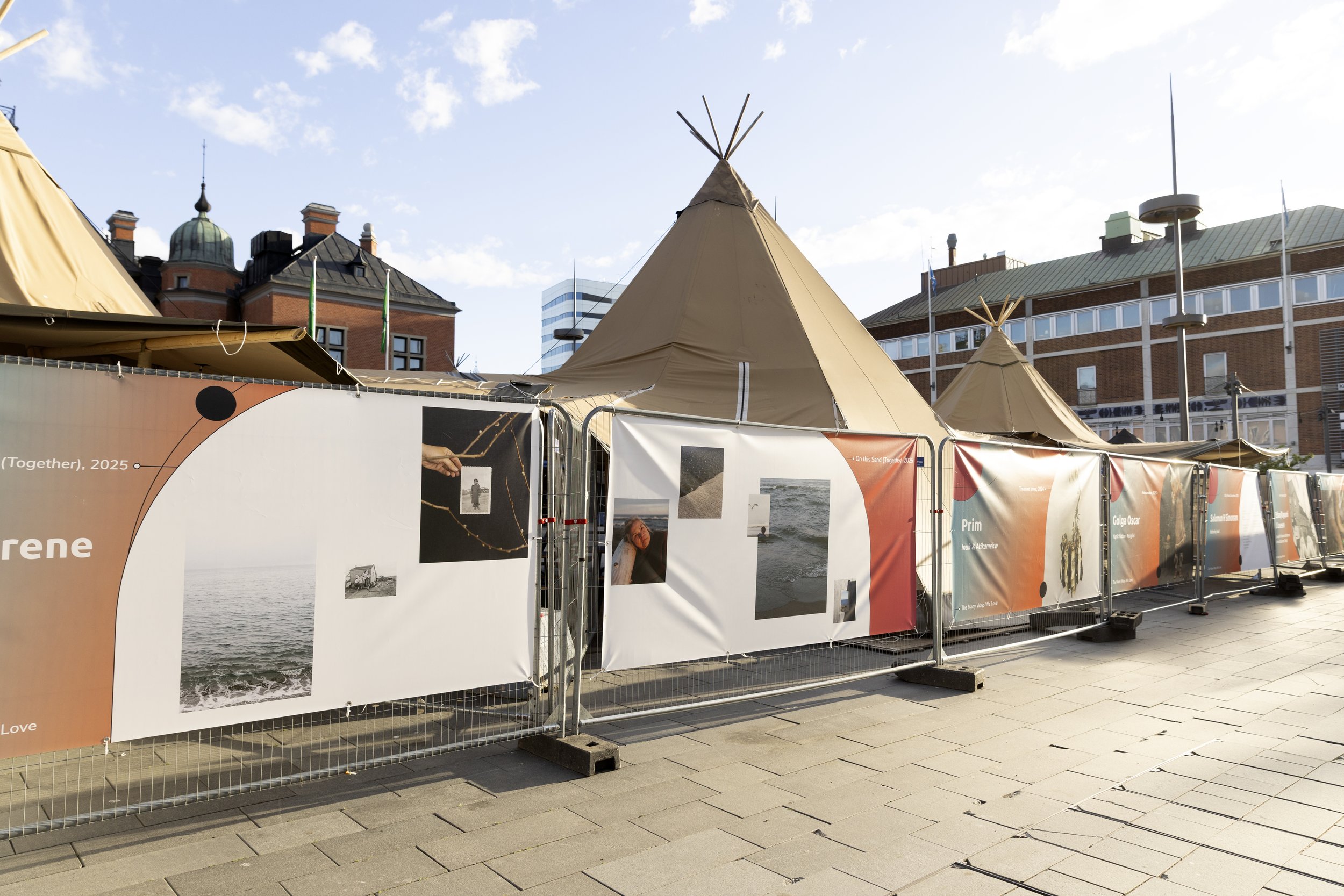
The Many Ways We Love features Queer, Trans, Non-Binary, and/or Two-Spirit (or LGBTI) artists across all visual art disciplines, including images of performance art, by Indigenous Peoples, national minorities, Black people, People of Colour and other artists originally from or currently residing in the North. The artworks were prominently displayed outdoors at the Arctic Arts Summit in a banner installation encircling one of the main public venues.
The Many Ways We Love draws on the essay of the same title by the late Inupiaq artist Jenny Irene, in which Jenny - whose life and work is celebrated for their deep commitment to visual storytelling with Indigenous, queer, and two-spirit communities - expresses a desire to see a future where all expressions of gender and sexuality are celebrated, and where everyone can freely express the many ways we love, anywhere in the North. We undertake this project with the support of Jenny's partner, Nora, and her friends and family in Alaska.
The Many Ways We Love is project of Curating Change led by Dr. Carla Taunton, Dr. Michelle McGeough, and Dr. Heather Igloliorte. The graphic design was done by Edie Skeard.
Featured artists:
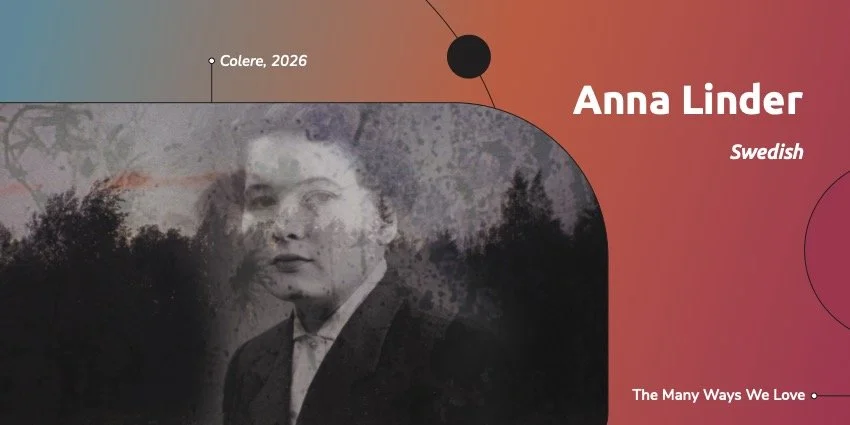
Anna Linder (Swedish)
Anna Linder is an artist with a main focus on moving images, installations & performances. Especially experimental & abstract art, processes, collectivity, periphery, interpersonal relations, family history & the work of the hand. Linder also works as a curator and cultural producer.
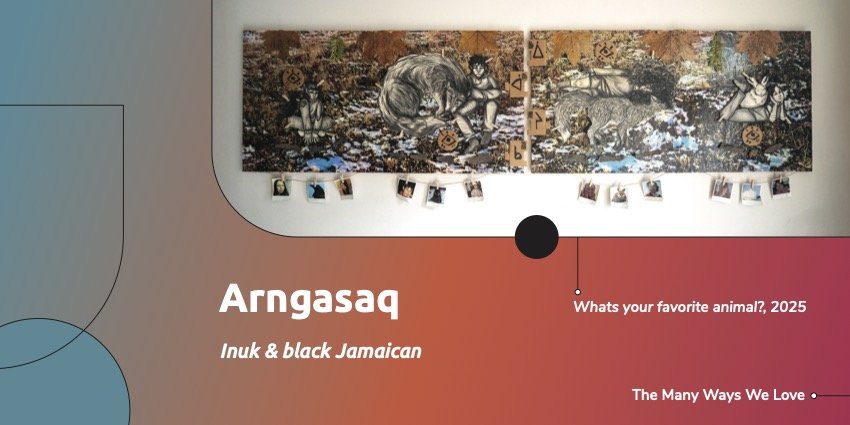
Arngasaq (Inuk and black Jamaican)
Arngasaq is a black Inuk artist that specializes in multi media arts, aiming to create for self expression-- their pieces touch subjects in all forms; trauma, politics, and cultural storytelling. Their art pieces are made from self interests-- with the main themes being supernatural, cultural and horror oriented.
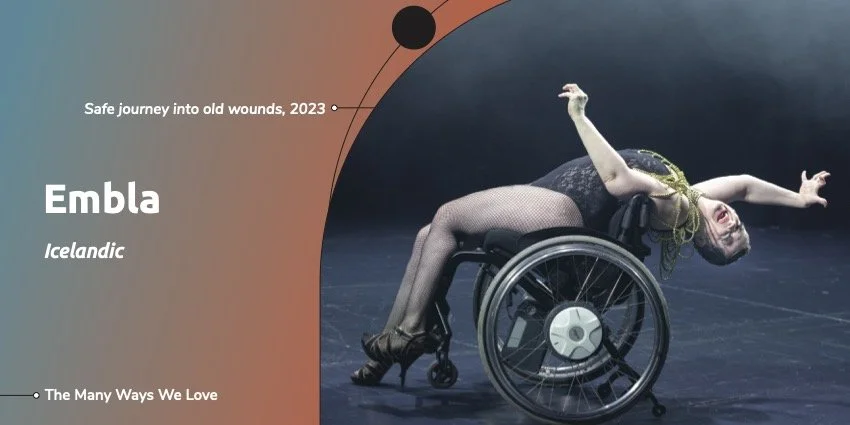
Embla (Icelandic)
Embla is a dancer and performer based in Iceland and her work is rooted in disability and queer pride. With an academic background in sociology, she has researched disability in relation to sexuality, shame, pleasure, and affect. In her artistic practice she brings these themes into performance through dance, movement, storytelling, and devised theatre, aiming to present unapologetic and sensual representations of disability and queerness on stage.
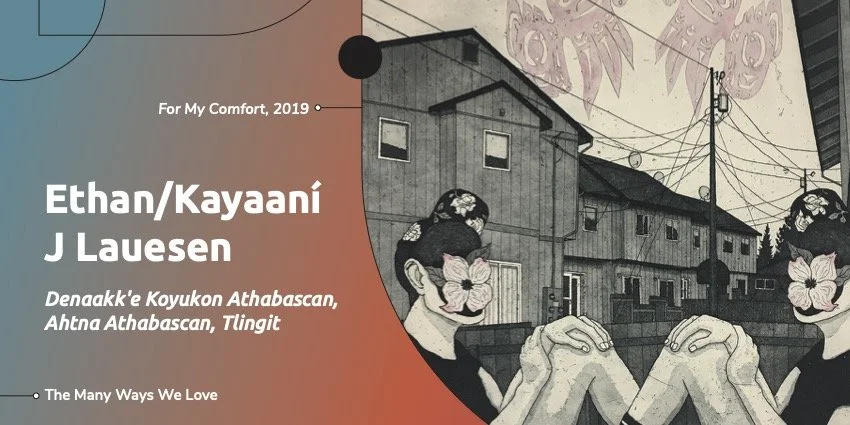
Ethan/Kayaaní J Lauesen (Denaakk'e Koyukon Athabascan, Ahtna Athabascan, Tlingit)
Ethan/Kayaaní J Lauesen is a visual artist based in Fairbanks, Alaska. They earned their Bachelor of Fine Arts from the University of Alaska Fairbanks in 2019. Their body of work focuses on their Denaakk’e Koyukon Athabaskan and Lingít cultural backgrounds, their queer identity, and how they are perceived in Alaskan communities. The prints, paintings, and drawings they produce are an intimate response to public perceptions of their Indigenous and Queer identities, encapsulating their personal narrative and experiences documenting cultural change.
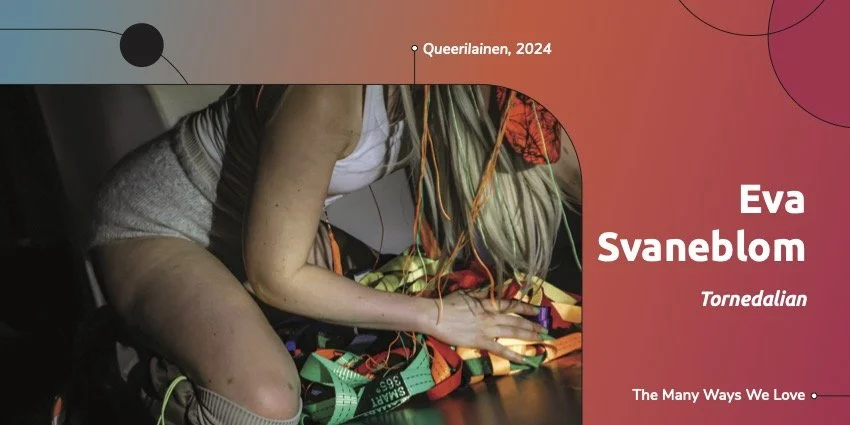
Eva Svaneblom (Tornedalian)
Eva Svaneblom (she/her) is a Tornedalian dance artist, based in Tromsø, Norway since 2020. Eva’s work takes many forms: from performances in gallery spaces or outdoors, to short videos on social media, and full-length productions in black box theatres. She works both solo and collaboratively, often across disciplines. She usually has both solo and collaborative projects running simultaneously. “That suits the way I like to work, and both approaches push my choreographic practice forward.” Eva also explores drag as an art form through the non-binary drag king Ei Ei. Ei Ei is fabulously queer and extra Tornedalian!
Since 2021 curating performing arts is also an extended part of her practice.
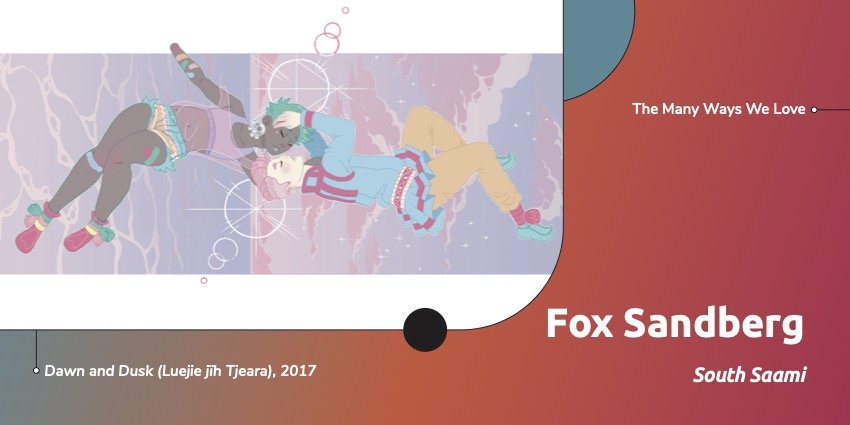
Fox Sandberg (South Saami)
Fox Sandberg (they/them) is a nonbinary, autistic South Saami artist, based in Lïkssjuo, Sweden. Fox's family has roots in Vualtjere, Sápmi, and Scotland. They hold a BA in Sequential Arts from the University of Gävle, and have worked as an illustrator and author, focusing in particular on South Saami and queer narratives, alongside a life-long passion for animals, in a number of different mediums.
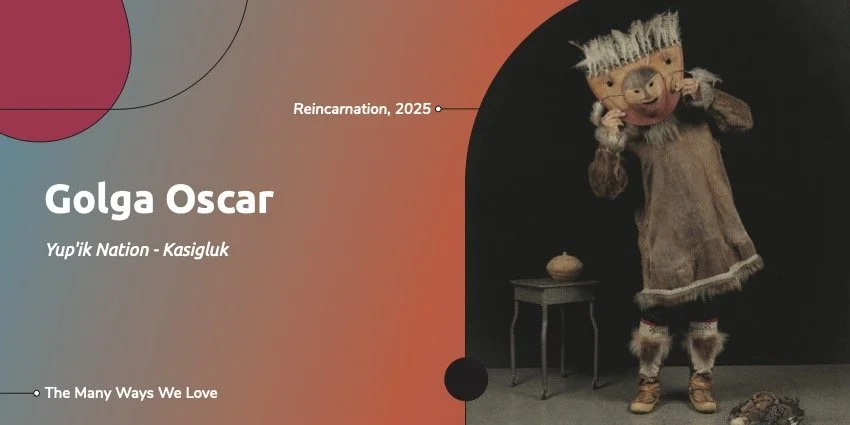
Golga Oscar (Yup'ik Nation - Kasigluk)
Golga Oscar, a Yup’ik artist from Southwest Alaska, creates artwork that reflects Yup’ik identity in both traditional and modern forms. His work is influenced by his Yup’ik ancestors and Indigenous artists all over Turtle Island. As a self-taught artist, Oscar has produced a variety of garments, from footwear to headwear. Living in a Western society, he challenges perspectives of what a Yup’ik lifestyle looks like.
Oscar also emphasizes digital art, such as graphic design and digital photography. Through the lens of the Indigenous perspective, his main goal is to Indigenize Western spaces, creating a welcoming environment for current and future Native artists in conquering the ongoing Western assimilation.
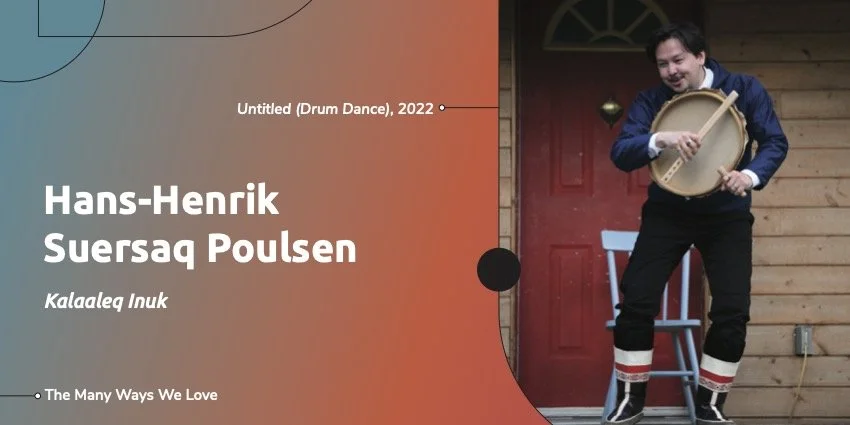
Hans-Henrik Suersaq Poulsen (Kalaaleq Inuk)
Hans-Henrik (HH) Suersaq Poulsen is an actor, singer, seamster, and artist, who graduated from The National Theatre School. He sings contemporary music infused with traditional elements such as throat singing and drum dancing. HH carries into the 21st century the living spirit of Kalaallit Nunaat´s ancient traditions, weaving them seamlessly into contemporary expression. HH also designs and creates contemporary and traditional garments (look out for his Anoraqs!). He has deeply explored other Inuit languages—making him able to communicate in the Inugguit dialect (North Greenlandic), Iivit dialect (East Greenlandic), as well as Inuktitut (the Canadian Inuit dialect).
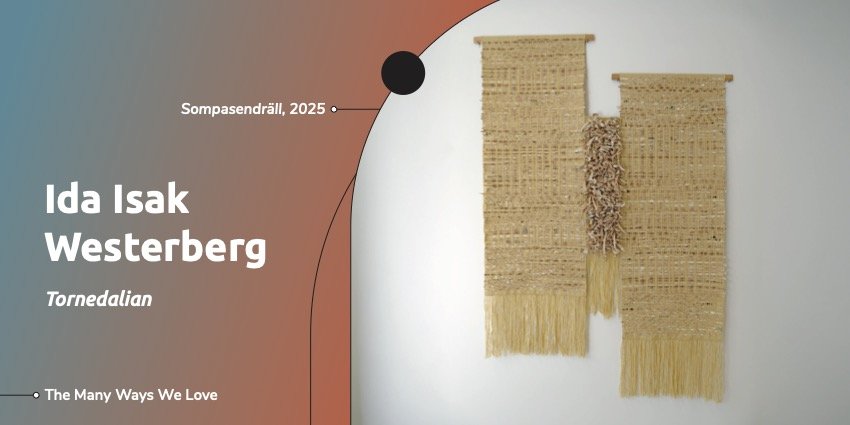
Ida Isak Westerberg (Tornedalian)
Ida Isak Westerberg has a degree in higher textile craft education at Friends of handicraft and is living and working as a textile artist in Luleå and Övertorneå. Westerberg works with site-specific processes where creation takes shape, nuances and woven qualities through a dynamic harmony between materials and how they react in relation to specific environments. Through collaboration with nature, with the bog Sompasenvuorna in Tornedalen as a recurring co-creator, Westerberg's sculptural weaves bear tactile traces of history, but also on questions of belonging, our changing desires and queer identities.
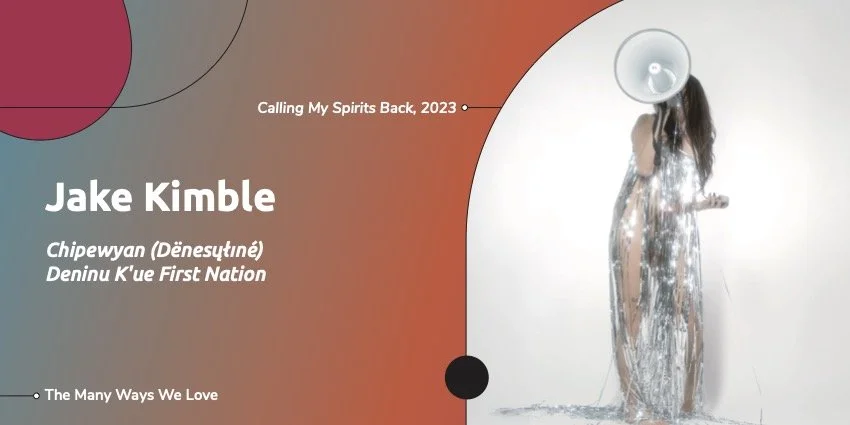
Jake Kimble (Chipewyan (Dënesųłıné) - Deninu K'ue First Nation)
Jake Kimble is a multidisciplinary Chipewyan (Dënesųłıné) artist and curator from Treaty 8 territory and belongs to the Deninu K’ue First Nation in the Northwest Territories. Kimble’s photographic practice revolves around acts of self-care, self-repair, and gender-based ideological refusal. Holding both a degree in Acting from Vancouver Film School as well as a BFA in Photography from Emily Carr University of Art + Design Kimble imbues his work with a sense of theatricality and levity, which are core principles in their practice. Through a clever subversion of the everyday aesthetics Kimble also plays with language and ambiguity – something that comes natural with them being a two-spirited artist. Using a funny bone as a tool, Kimble excavates themes of existentialism, narcissism, and the strange, offering an invitation to the audience to examine the absurdities that exist within the everyday so that they too may exhale, unclench, and even chuckle in the spaces where laughter is often lost.
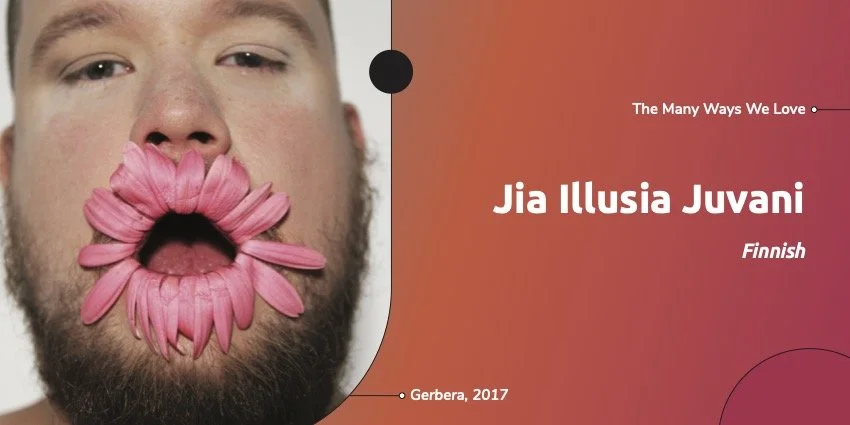
Jia Illusia Juvani (Finnish)
Jia Illusia Juvani is a non-binary body, trans and queer artivist originally from Ylitornio, Finland. The Young Artist of the Year 2018. As a child their idol was Ursula from The Little Mermaid.
At the core of their work you can find subjects like queer, feminism, death, lust, poetry, love, hate, stereotypes, worn out clichés and general silliness. Their main mediums are video, photography, sound, objects and text.
They currently live and work in Hyvinkää, Finland.
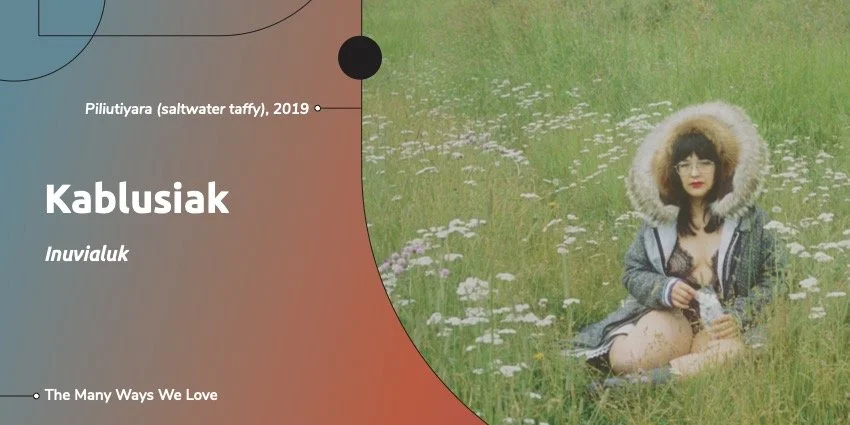
Kablusiak (Inuvialuk)
Inuvialuk artist Kablusiak (they/she) lives and works in Edmonton, Alberta. They create works using a variety of materials, including soapstone, permanent marker, sheets, felt, fur, and words. Her work explores the connections and ruptures between existence within and outside Inuit Nunangat, the impacts of colonization on the expression of gender and sexuality, the desire to make people laugh, and everyday life. Their work has been recognized with numerous awards including the Lieutenant Governor of Alberta's Arts Award (2020), the 2019 Sobey Art Award (semi-finalist) representing the Prairies and the North, the 2021 and 2023 Kenojuak Ashevak Memorial Award (semi-finalist), the 2023 Lieutenant Governor of Alberta's Arts Award, the Gattuso Award and the prestigious 2023 Sobey Art Award.
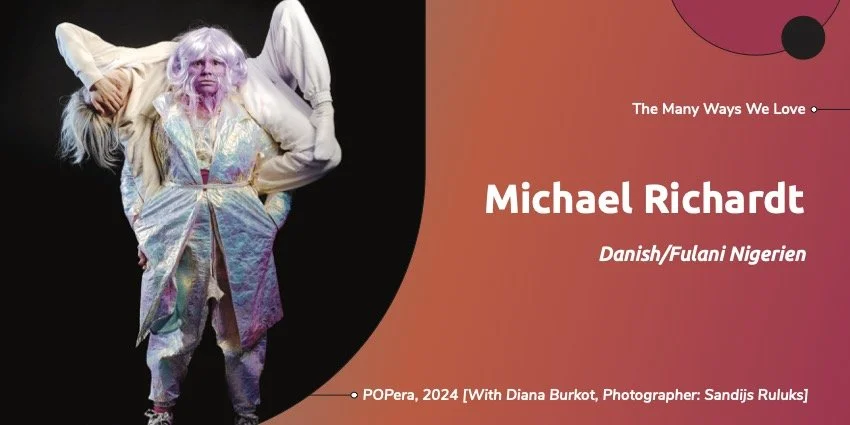
Michael Richardt (Danish/Fulani Nigerien)
Michael Richardt (DK/NE) is a performance artist specialising in time-based and long-durational performance. His practice includes video, film, photography, choreography, sculpture, writing, installation, painting, drawings, prints, artist books, collages and music. Richardt is a matriarchal thinker and creates work using a self-developed system anchored in spectral colours and the physical body. His performances have lasted from 13 consecutive days to a split second.
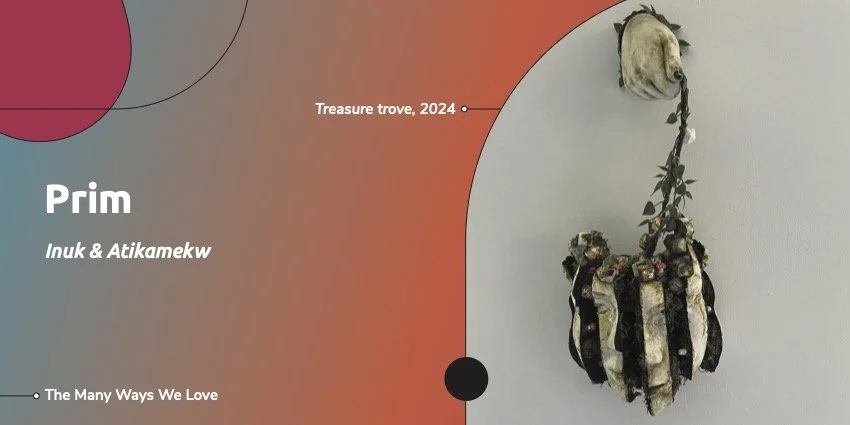
Prim (Inuk and Atikamekw)
Prim (Pasa Mangiok) is a 4th generational artist, Their great-grandmother being a seamstress, their grandmother Passa Mangiuk a lino printer, painter and occasionally draws. While their father, Thomassie Mangiok is a graphic designer/illustrator. Prim identifies as two spirited, and is part of the LGBTQ+ community. Prim is a mixed Inuit and atikamekw artist, Originally from Nunavik, Ivujivik but currently resides in Montreal to complete their BFA in Studio Arts in Concordia.
Prim mainly focuses on creating artwork to challenge what Inuit art is, and what it can be, and their mediums vary from beading, sewing, sculptures, and experimenting with materials, along with paintings and drawings. As of right now, they’ve become interested in combining both their atikamekw and Inuit heritage in their artwork, and further plans to research deeper in Inuit shamanism and Indigenous spirituality.
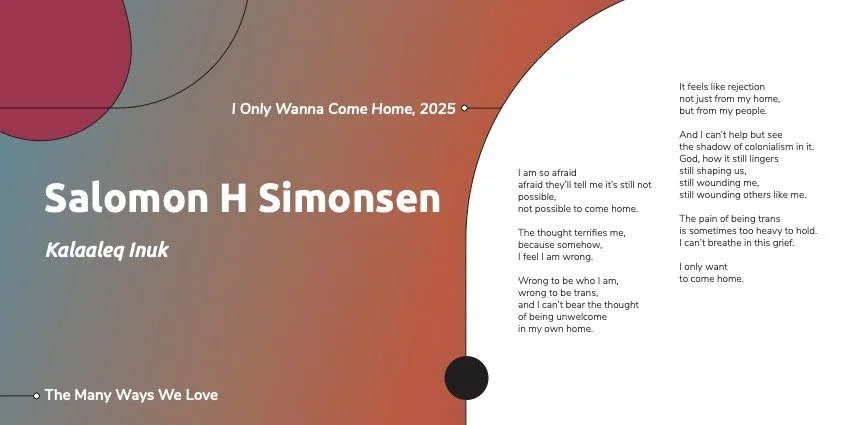
Salomon H Simonsen (Kalaaleq Inuk)
Salomon H Simonsen is a Greenlandic Inuk writer based in Denmark. Their work explores displacement, trans identity, exile, belonging, and the ongoing impact of colonialism. Through poetry and prose, they reflect on what it means to long for home while feeling separated from it.
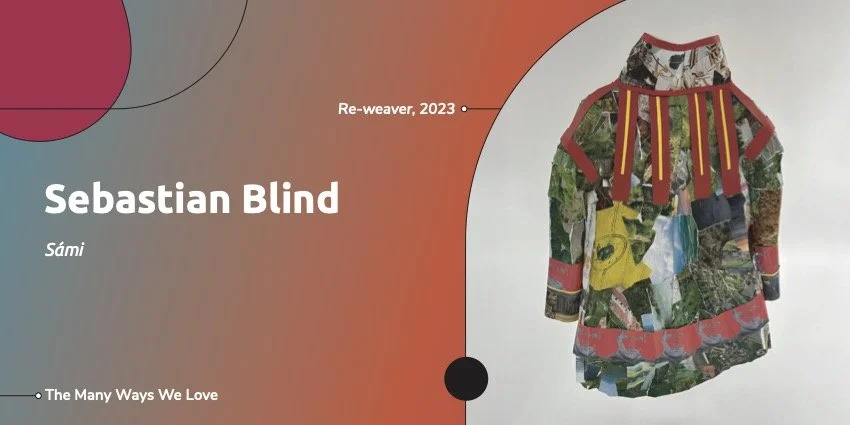
Sebastian Blind (Sámi)
Sebastian Blind works with reweaving himself to his Sámi heritage and his relationship to the noaidi as a bearer of knowledge, with a deepened connection to the drum as a ritual and historical tool for healing, communication, and navigation between different world levels.
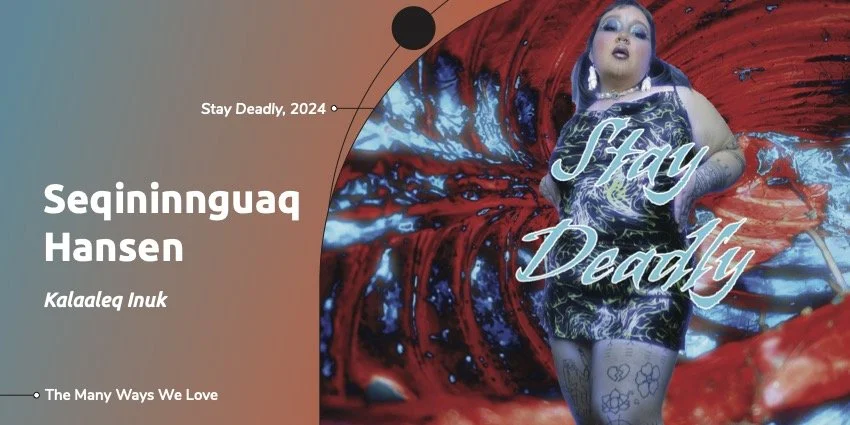
Seqininnguaq Hansen (Kalaaleq Inuk)
Seqininnguaq/Siqiniq is an awarded multimedia artist and Indigenous rights advocate from the Inuit community of Kalaallit Nunaat and has spent most of their life exploring their identity as a queer Inuk in many different ways.
Curators:
Dr. Michelle McGeough
Dr. Michelle McGeough (Cree Métis/Settler) completed her PhD in Indigenous art history at the University of New Mexico. Prior to returning to school for her advanced degree, she taught Museum Studies at the Institute of American Indian Art and was the Assistant curator at the Wheelwright Museum of the Native American Indian in Santa Fe, New Mexico. Dr. McGeough has a Master’s degree from Carleton University as well as a BFA from Emily Carr and an undergraduate degree from the Institute of American Indian Art. She also has a B.Ed. degree from the University of Alberta. Dr. McGeough currently teaches at Concordia University in the Art History department.
Dr. McGeough’s research interests have focused on the indigenous two-spirit identity. She is a board member of daphne, the first Indigenous artist run centre in Tiohtià:ke and the IF collective. Dr. McGeough is a co-applicant in the SSCHR Thinking Through the Museum Partnership grant, Queer Operatives, and The Morrisseau Project, and Curating Change. Her essays have appeared in C-space, Union Docs, and an upcoming volume entitled Two-Spirit, Indigiqueer, and LGBTTQ* Interventions into Museums, Archives, and Curation.
Dr. Heather Igloliorte
Dr. Heather Igloliorte, an Inuk-Newfoundlander and Nunatsiavut beneficiary, is the Canada Excellence Research Chair in Decolonial and Transformational Indigenous Art Practices at the University of Victoria, BC, where she is a Professor in the Visual Arts Department (2023-). Since 2018 Heather has directed the nation-wide Inuit Futures in Arts Leadership: The Pilimmaksarniq / Pijariuqsarniq Project (2018-2026), a SSHRC-funded partnership grant which supports Inuit postsecondary students to explore professional career paths in all aspects of the arts, including collections management, curatorial practice, arts administration and other areas of the visual and performing arts, in order to address the longstanding absence of Inuit in agential positions within Canadian art history and museum practice.
Igloliorte formerly held a Tier 1 University Research Chair in Circumpolar Indigenous Arts at Concordia University in Montreal, QC, where she was the co-founding director of the Indigenous Futures Research Centre with Prof. Jason Edward Lewis. She has been an independent curator since 2005, and has created or co-created more than thirty curatorial projects throughout her career. In recognition of her contributions to curatorial practice in Canada, in 2021 Igloliorte was awarded The Hnatyshyn Foundation's Award for Curatorial Excellence in Contemporary Art. In addition to her curatorial practice, Igloliorte teaches curatorial studies, critical museology, global Indigenous art history and research-creation at the University of Victoria.
Dr. Carla Taunton
Dr. Carla Taunton, a white-settler scholar, is an Associate Professor in the Division of Art History and Contemporary Culture at the Nova Scotia College of Art and Design University (NSCAD). Her research contributes to arts-based critiques of settler colonialism and engages with theories of decolonization and inter-generational settler responsibility. She recently co-edited PUBLIC 64 Beyond Unsettling: Methodologies Towards Decolonized Futures and The Routledge Companion to Indigenous Art in the United States and Canada. As a core research team member on several SSHRC grants, such as Inuit Futures, Thinking through the Museum and Counter Memory Activism she leads curatorial, publication and research creation projects as well as co-organizes public lecture series, workshops, and symposia. Her current research project, Curating Change explores curatorial activisms in settler colonial contexts and mobilizes collaborative curatorial incubators as a methodology towards activating inter-cultural, decolonial and anti-racist social change.